Tre Sette Rules
Three Sevens, the quiet, serious one: no drumpfs, you must follow suit, and partners don't say a word
The last one from the family, for now
Tre Sette is here for the same reason Scopa is. NewfieCards is about family, and my wife's family is my family.
Tre Sette is not playable yet Future Plans
There's no table for it yet and nothing in the lobby's create-a-room menu for it. The rules are here so you can learn the game before the table opens.
These are the rules as commonly played, not this table's rules yet
What's below is Tre Sette the way it's played across Italy, written out in plain English. Few games are argued over at the kitchen table more than this one, and wherever families commonly play it differently, I've said so right there in the rules.
Before a single card of Tre Sette gets dealt on NewfieCards, I'm asking my wife's family how they play it, and the table will play it their way. Treat this page as a starting point, not a promise.
What You're Trying to Do
Take tricks with the cards that count, as partners. The first side to 31 points wins the game.
Tre Sette means "three sevens". Where the name came from is anybody's guess, and every family has its own story.
Some families play to 21 or 41 instead. You'll also hear it called Tressette, all one word, and Spanish families call it Tresiete (three seven). We'll set this to how our family plays.
The Deck
What Beats What
The order is strange the first time, so here it is, highest to lowest in every suit:
3, 2, Asso (ace), Re (king), Cavallo (knight), Fante (knave), 7, 6, 5, 4
Yes, the 3 beats the ace. The 3 and the 2 are the bosses.
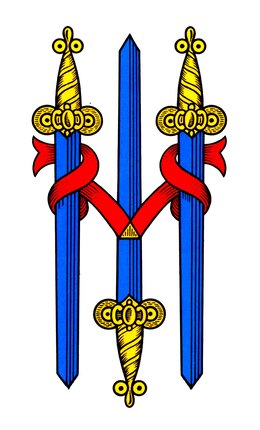
(highest)
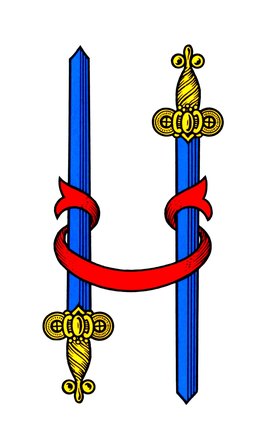
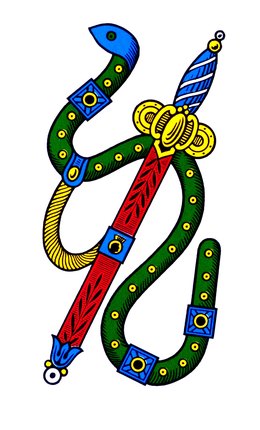

Card images: a Neapolitan deck, public domain, from Wikimedia Commons, the same pictures as the Scopa page.
What It's Worth
| Card | Points |
|---|---|
| Each Asso (ace) | 1 |
| Each 3, 2, Re (king), Cavallo (knight) and Fante (knave) | a third of a point |
| 7, 6, 5, 4 | nothing |
| Taking the last trick | 1 |
That's 11 and two-thirds points in a hand. Thirds only count in threes, so at the end of each hand any leftover thirds are dropped and every hand is worth 11 points.
Some families carry the leftover thirds over to the next hand instead, and some don't give anything for the last trick. We'll set this to how our family plays.
Players and the Deal
Four players, in partners, sitting across from each other. The dealer gives everybody ten cards, five at a time, so the whole deck is dealt and there's nothing left to pick up. Play goes to the dealer's right, and the player on the dealer's right leads.
Some families play to the left, and it can be played with two or three as well. This site will start with four.
Playing a Trick
- You must follow suit if you can. Only if you have none of the suit led can you play something else.
- The highest card of the suit led takes the trick. Nothing else can win it: with no drumpfs, a card of another suit is just thrown away.
- Whoever takes the trick leads the next one.
Declarations
If you're dealt one of these, you declare it when you play your first card, and your side scores it right away:
- Napoletana (the Neapolitan), also called buon gioco (a good hand): the Asso (ace), 2 and 3 of the same suit. 3 points.
- Three 3s, three 2s or three aces. 3 points.
- All four 3s, 2s or aces. 4 points.
Not every family counts declarations at all. Some lay the cards down to show them, some just say it, and some give extra for a longer Napoletana (the Neapolitan) with the 4 and up. We'll set this to how our family plays.
Partners Don't Talk
This is the rule the game is famous for. You can't tell your partner what you hold, by word, face or wink. All you have is the cards you play.
Many tables allow exactly three signals, made only by the player leading a trick: busso (I knock), meaning "play your best card in this suit and lead it back to me"; striscio (I slide), meaning "I have more of this suit"; and volo (I fly), meaning "that's my last one". Whether they're allowed is one of the things families argue about most. We'll set this to how our family plays.
Winning
Count up at the end of every hand. The first side to reach the target wins. If both sides get there in the same hand, the higher score wins; if they're tied, play another hand.
Some families let a side call itself out in the middle of a hand once it has enough, and some count taking every trick, the cappotto (a clean sweep), as an outright win.
A Few Tips
- A 3 or a 2 on its own is a sitting duck. Lead the suit you hold the 3 and 2 of, and the ace will fall to you.
- Count the cards. With no drumpfs, knowing who's out of a suit is everything.
- Save the last trick: it's worth more than any single card.
Tre Sette isn't in the lobby yet, but plenty of other games are. Create a free account and go to the Game Lobby to play one of them.