Escoba del 15 Rules
The Spanish and Argentine game of the Scopa family: forty cards, four on the table, and every capture makes fifteen
The name, and where the game is played
Escoba del 15, also written Escoba de quince, is the Spanish and Argentine game of the Scopa family. It is played in Spain, Argentina, Uruguay and Chile. In Italy the same game is called Scopa di Quindici; in Brazil it is Escova; in most of Spain and Argentina people just say Escoba.
Escoba is Spanish for broom, and scopa is Italian for broom. It is the same word, and both games are named after it for the same reason: taking every card off the table at once is sweeping it, and that sweep is the point the whole game is played for. Quince is Spanish for fifteen, and quindici is the Italian. So the name means the broom of fifteen.
If you know Scopa, everything here will feel familiar except the one thing that matters most: how a card takes.
Escoba del 15 is playable, and it's in beta
Escoba del 15 is in the lobby now. Start a table for two, three or four and you'll be seated with computer players. Four play in fixed partnerships, sitting across from your partner.
Beta means it's new, not that it's broken. A test script has played hundreds of matches of it, and on 28 September 2026 I played a whole game of it by hand, start to finish, and it worked. Not every combination has been played by a person yet (every number of players, both ways a card can take, every setting), so it stays in beta until they have. If something looks wrong, report it as a bug.
How a Card Takes
The fifteen is not a score to play to. It is how you take cards. The card you play takes any set of cards on the table that adds up to exactly fifteen together with it. A seven takes an eight. A seven takes a five and a three. A seven does not take another seven, because that is fourteen. The Sota is worth eight, the Caballo nine and the Rey ten.
If the card you play can take something, you must take it. You may play a card that takes nothing, and it stays on the table. But you may not play a card that makes fifteen and then leave it there.
Worked through: the table shows a 3, a 5 and a Sota (knave, 8). Play a 7 and you choose: the Sota, or the 3 and the 5. Play a 4 and you take the 3 and the Sota. Play a 2 and you take the 5 and the Sota. Play a Rey (king, 10) and you take the 5. Play a 6 and you take nothing, so the 6 is laid down beside the rest.
When a card can take more than one way, which set to take is your choice. At this site's table you tap the table cards you are taking, then drag your card at the table.
The Deck
Forty cards in four suits, Oros (coins), Copas (cups), Espadas (swords) and Bastos (clubs), each running from the As (ace) to 7 and then three court cards. For taking cards a card is worth:
| Card | Worth |
|---|---|
| As (ace) through 7 | 1 to 7, face value |
| Sota (knave) | 8 |
| Caballo (horse) | 9 |
| Rey (king) | 10 |
The table here draws the forty cards with the same Neapolitan pictures as its Scopa table, which carry the same forty cards in Italian artwork. The seven of coins, the one card worth a point on its own, and the three court cards:
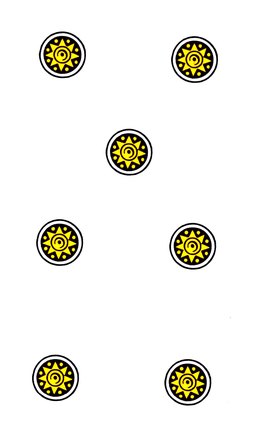
(7 of Oros, coins)
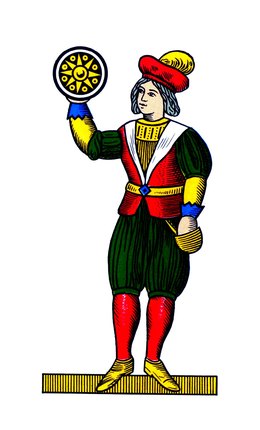
(knave of coins, worth 8)
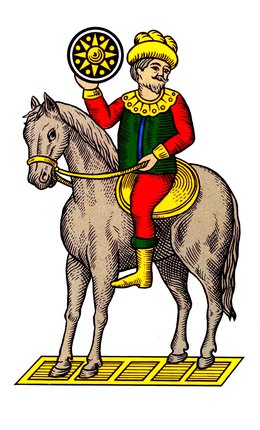
(horse of coins, worth 9)
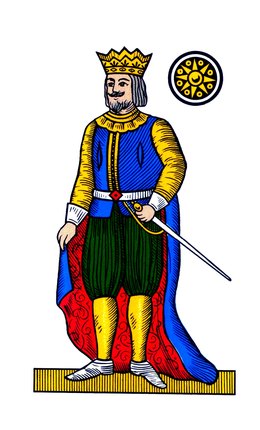
(king of coins, worth 10)
Card images: a Neapolitan deck, public domain, from Wikimedia Commons (uploader Trocche100, released into the public domain; retrieved 2026-09-21).
Players and the Deal
Two to four players. Four play in fixed partnerships, sitting across from your partner. Three play as individuals. Play runs to the dealer's right.
The dealer gives three cards to each player and lays four face up on the table. When every hand is empty the dealer deals three more each, and none to the table, until the deck is gone.
An Escoba: Sweeping the Table
Clearing the table is an escoba, a sweep, and it is worth a point on its own. The card that did it is laid face up on your pile so the escobas can be counted at the end.
The four cards dealt face up can make an escoba too, before anybody has played: see the first two settings below.
The End of a Hand
At the end of a hand the cards still on the table go to whoever made the last capture. There is always at least one, because the forty cards are worth two hundred and twenty between them and that is not a multiple of fifteen.
Scoring a Hand
Each hand is worth four points and then some: one for the most cards, one for the most Oros (coins), one for the siete de velo, the seven of coins, and one for the best setenta, which is your best card in every one of the four suits added up, counting a seven as 21, a six as 18, an As (ace) as 16, then 15, 14, 13, 12 down the numbers, and every court card as 10. If you have taken no card at all of some suit you cannot win the setenta. A tie for cards, coins or the setenta gives the point to nobody. On top of that, a point for every escoba.
| Point | Goes to |
|---|---|
| Cartas (cards) | The most cards taken |
| Oros (coins) | The most cards of the coins suit |
| Siete de velo | Whoever took the seven of coins |
| Setenta | The best card of each suit, added up |
| Escobas (sweeps) | One point each |
Winning
Playing to 15 is usual in Spain, and the host may choose 10, 21 or 30 instead. Do not confuse this 15 with the fifteen you capture with: one is how many points win the match, the other is how you take cards.
The Italian Hybrid
The Italian hybrid. Pagat describes an Italian version of this game, Scopa di Quindici, that mixes Escoba's capture with Scopa's, and the host can switch it on. Then the card you play may also take a table card of its own value, or cards that add up to its own value, as in Scopa: a seven takes another seven, or a four and a three, as well as an eight. When a card can take in more than one way, you choose which. You must still take if you can. Clearing the table with the very last card of a hand does not count as an escoba.
The Host's Settings
Where the published sources disagree, the host chooses before the deal. The box offers exactly these, in these words:
| Setting | What it does | Unless changed |
|---|---|---|
| Playing to | First to this total wins the match, and must be strictly ahead. 10 makes a short game. 15 is the usual Spanish number, given by the Spanish Wikipedia article and Ludoteka. 21 is what Pagat gives for Escoba, and 30 is what the Juegos Bonaerenses tournament rulebook gives. | 15 points |
| An opening table adding to 15 goes to the dealer | On: if the four cards turned face up at the deal add to fifteen, the dealer takes all four and scores an escoba before anybody plays. Off: they stay on the table and play begins as usual. | On |
| An opening table adding to 30 | Only read when the rule above is on, and only when the four cards really do split into two fifteens. Pagat and Ludoteka score it two; the Juegos Bonaerenses rulebook scores it nothing. | Two escobas for the dealer |
| All ten Oros (coins) scores an extra point | Off: taking every coin wins the ordinary Oros point and nothing more. On: it wins an extra point as well. Pagat calls this a regional variation; the English Wikipedia article lists it as a standard point. | Off |
| All four sevens scores an extra point | Off: taking every seven wins the setenta and the siete de velo (the seven of coins) and nothing more. On: it wins an extra point as well, which is the same total Pagat describes as 'three points instead of two'. | Off |
| Which cards a card may take | Spanish: a card takes only table cards that add up to fifteen with it, so a 7 takes an 8, or a 5 and a 3, but never another 7. Italian hybrid: a card may also take a table card of its own value, or cards adding up to its own value, so a 7 takes a 7, or a 4 and a 3, as well. When a card can take more than one way, the player chooses which, and a card that can take must take. | Spanish: only cards that make fifteen with yours |
To join a game waiting for players, to start your own game, or simply spectate a public game in progress, create a free account and go to the Game Lobby.