Briscola Rules
The other Italian game everybody knows: forty cards, three in your hand, and one suit turned up as drumpf
Another one from the family
Briscola is here for the same reason Scopa is. NewfieCards is about family, and my wife's family is my family.
Briscola is not playable yet Future Plans
There's no table for it yet and nothing in the lobby's create-a-room menu for it. The rules are here so you can learn the game before the table opens.
These are the rules as commonly played, not this table's rules yet
What's below is Briscola the way it's played across Italy, written out in plain English. Like every good kitchen game it changes a little from family to family, and wherever families commonly play it differently, I've said so right there in the rules.
Before a single card of Briscola gets dealt on NewfieCards, I'm asking my wife's family how they play it, and the table will play it their way. Treat this page as a starting point, not a promise.
What You're Trying to Do
Win tricks with cards that are worth something. There are 120 points in the deck. Take 61 and the hand is yours. If it comes out 60 each, nobody wins that hand.
A game is usually the best of three hands.
Some families play one hand, some the best of five, and some deal a 60 each hand again. We'll set this to how our family plays.
The Deck
Forty Italian cards in four suits, the same deck as Scopa:
- Coppe (cups)
- Denari (coins)
- Spade (swords)
- Bastoni (clubs)
Each suit runs ace to 7, then three court cards: the Fante (knave), the Cavallo (knight) and the Re (king).
Some families, Spanish and Argentine ones especially, call the game Brisca (the Spanish name) and play it with Spanish cards. It's the same game.
What Beats What, and What It's Worth
Forget everything you know from 120s. In Briscola the Asso (ace) is top, and the 3 is right behind it. Highest to lowest:
| Card | Points |
|---|---|
| Asso (ace) | 11 |
| 3 | 10 |
| Re (king) | 4 |
| Cavallo (knight) | 3 |
| Fante (knave) | 2 |
| 7, 6, 5, 4, 2 | nothing |
Add them up and every hand has exactly 120 points in it. The little cards are worth nothing, but they're what you throw away when you don't want to give anything up.
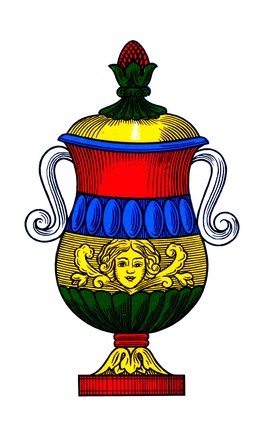
11 points
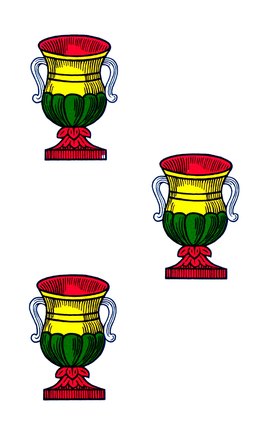
10 points
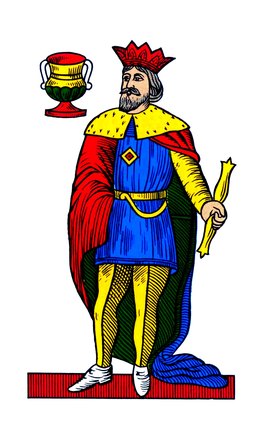
4 points
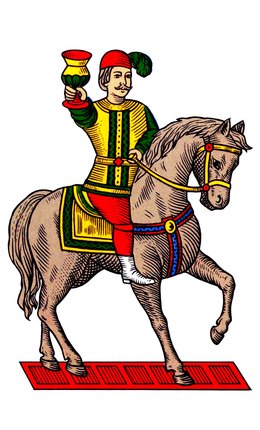
3 points
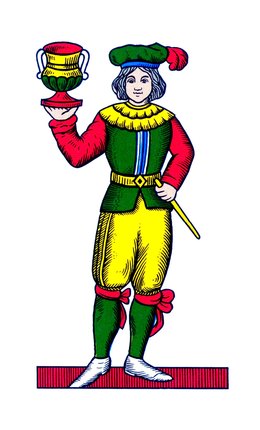
2 points
Card images: a Neapolitan deck, public domain, from Wikimedia Commons, the same pictures as the Scopa page.
Players
- Two players, head to head. This is the classic game.
- Three players, each on their own. Take one of the 2s out first so the deck comes out even (39 cards).
- Four players, in partners, sitting across from each other. Your partner's points are your points.
Some families take a different 2 out for three players, and some only ever play with two or four. We'll set this to how our family plays.
The Deal
The dealer gives everybody three cards, one at a time. Then the next card is turned face up and laid crossways under the rest of the deck, so you can always see it. That card's suit is drumpf for the whole hand. It stays there until the very end, and it's the last card anybody picks up.
Playing a Trick
The player to the dealer's right leads first, and play goes round to the right. Each player puts down one card. You don't have to follow suit. Play anything you like. That's the big difference from 120s and Tre Sette.
Who takes it:
- If anybody played a drumpf, the highest drumpf takes the trick.
- If nobody did, the highest card of the suit that was led takes it. A card of some other suit can't win, no matter how big it is.
Some families play to the left instead. We'll set this to how our family plays.
Picking Up
After every trick, while there's still deck left, everybody picks up one card so you're back to three. The player who took the trick picks up first, then the others in turn. The turned-up drumpf is the last card in the deck, so whoever's turn it is at the very end gets it.
The one who took the trick leads the next one. Once the deck is gone you play out your last three cards with no more picking up.
Swapping the Drumpf Card
If you hold the 2 of drumpfs, you can swap it for the turned-up drumpf card on your turn, as long as there's still deck left to pick up from.
A lot of families do this with the 7 of drumpfs instead. Some say "the 7 if the turned card is a big one, the 2 if it's a small one", and some don't swap at all. We'll set this to how our family plays.
Looking Back
You can have a look at the last trick taken, but not the ones before it. Keep count in your head!
Some families don't allow even the one look back.
Partners (Four Players)
Partners play to help each other. If your partner's winning the trick, throw a big point card on it: that's carico (loading it up). If the other side's winning, keep your points home and throw a little card: that's liscio (a smooth one).
At a lot of kitchen tables partners make faces at each other to show what drumpfs they hold. Online, there's no signalling and no table talk about your cards.
Some families let partners show each other their hands once the deck runs out. We'll set this to how our family plays.
Counting Up
When all the cards are played, each side counts the points in the tricks it took. 61 or more wins the hand.
Some families count a hand where one side takes all 120 points as something extra.
A Few Tips
Variants You'll Hear Named
Mentioned here only so they're recognisable. None of them is planned:
- Briscola chiamata (called Briscola): for five, where the high bidder calls a card and whoever holds it is their secret partner.
- Briscolone (big Briscola): five cards each, no drumpf, and you must follow suit.
- Briscola scoperta (open Briscola): everybody's hand is face up.
Briscola isn't in the lobby yet, but plenty of other games are. Create a free account and go to the Game Lobby to play one of them.