Scopa Rules
The Italian sweeping game: forty cards, four on the table, and a seven of coins worth going to war over
Why an Italian game is on a Newfoundland card site
Straight up: Scopa is not a Newfie card game. Nobody's Nan on the northeast coast was sweeping the table for the sette bello. But I never built NewfieCards to be only about Newfoundland. I built it about family, and about the games families sit down and play together.
I'm a Newfie married to an Italian princess. She's part of my greater Newfie family now, and her people are my people. So this game is here to honour that: it's the game she used to play with her Nonno (grandfather) and her Nonna (grandmother), her Nonni (grandparents) together, with a forty-card Italian deck at their table.
It's for her Nonno and Nonna themselves, too, who invited me into their home. Her grandfather shared his grappa with me and explained the proper way to make a good wine, and then grappa from the skins. Her grandmother showed me the proper way to cook a proper Italian meatball, decided I was too thin, and kept adding food to my plate until I physically removed the plate from the table and away from the spoonful she was trying to add to it. I almost exploded at every meal I had at that table.
Every family has a game. This one is theirs, and every other Italian family's, separated by distance but still connected through love.
Scopa is not playable yet Coming Soon
There's no table for it, no engine behind it, and nothing in the lobby's create-a-room menu for it. It's a name on the "Games" list and a set of rules to read, for now.
These are the rules as commonly played, not this table's rules yet
What's below is Scopa the way it's commonly described in published accounts of the game, written out here in plain English. It is not a description of anything this site deals, because this site doesn't deal it at all yet. Scopa varies from region to region and from kitchen to kitchen the way every good family game does: the target score, whether you're obliged to capture when you can, and which of the named variants are in all change from table to table.
I've already overruled a published source on 120s more than once because my own family plays a hand a little differently, and the same will go double here, where I can ask the family that plays it directly. Before a single card of Scopa gets dealt on NewfieCards, the house rules it will use are still mine to settle. Treat everything on this page as a starting point, not a promise.
Objective
Capture cards off the table, and capture the right ones. At the end of every round four points are on offer (most cards, most coins, the seven of coins, and the best primiera), plus a point for every time you swept the table bare. First to 11 wins.
Scopa is simply the Italian for broom. The game is named after the move that clears the table.
The Deck
Scopa is played with a 40-card Italian deck, not the 52-card deck the rest of this site uses. Four suits, ten cards each, no 8/9/10 pip cards and no jokers:
- Coppe (cups)
- Denari (coins)
- Spade (swords)
- Bastoni (clubs, or batons)
Within a suit the cards run 1 to 7 and then three court cards, and for every purpose in Scopa a card is worth its number:
| Card | Counts as |
|---|---|
| Asso (ace) through 7 | 1 – 7, face value |
| Fante (knave) | 8 |
| Cavallo (knight) | 9 |
| Re (king) | 10 |
There is no trump suit and no ranking of one suit over another. A 6 of cups and a 6 of swords are the same thing to a capture; the suits matter only when the round is scored.
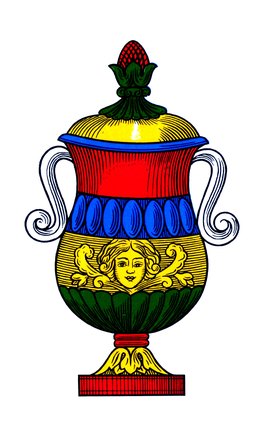
(ace of cups)
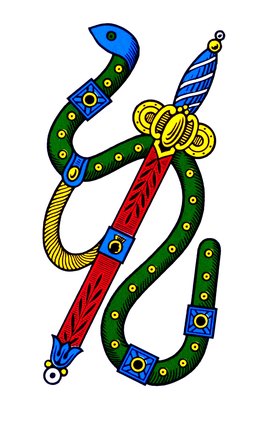
(ace of swords)
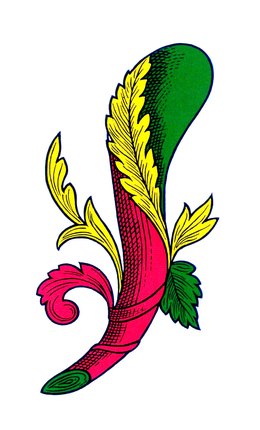
(ace of clubs)

(seven of coins)
And the three court cards, here in coins. The same three figures appear in every suit:
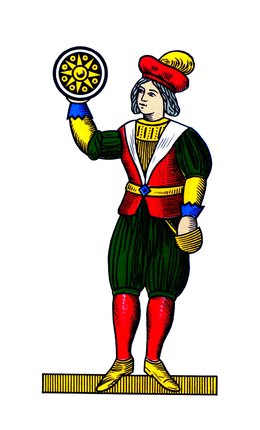
(knave, worth 8)
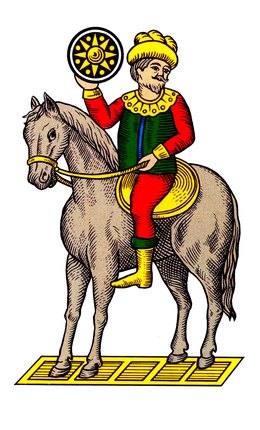
(knight, worth 9)

(king, worth 10)
Card images: a Neapolitan deck, public domain, from Wikimedia Commons (uploader Trocche100, released into the public domain; retrieved 2026-09-21). Attribution isn't required by the licence. It's here because knowing where a picture came from is worth more than the licence asks.
Decks differ by region. A Neapolitan deck (pictured) and a Piacentine deck carry the same forty cards in different artwork; some Tuscan decks put a Donna (queen) where the Cavallo sits. The game is the same. A 52-card deck also works if you take out the 8s, 9s and 10s and read jack–queen–king as 8–9–10.
Players and the Deal
- Two to four players. Two head to head is the classic game; four is played in fixed partnerships, sitting across from your partner. Three play as individuals.
- The dealer gives three cards to each player, face down, and lays four cards face up in the middle of the table.
- When everybody has played out their three cards, the dealer deals three more each from the stock, and no more cards go to the table. That repeats until the deck is gone, which ends the round.
- A common courtesy rule: if three or more kings land face up on the opening table, the deal is void and the whole hand is dealt again. Three kings on the table is close to unplayable, since only a king can take a king.
The turn passes one seat at a time around the table, starting with the player to the dealer's right.
Capturing
On your turn you play one card from your hand, face up. One of two things happens:
- It captures. Your card takes one table card of the same value, or a set of table cards whose values add up to yours. Everything captured, plus the card you played, goes face down in front of you in your own pile.
- It doesn't. The card you played stays on the table, face up, for everybody else to capture. That's not a penalty; it's half the game.
Worked through: the table shows 3, 4, 5 and a Re (10). Play a 4 and you take the 4. Play a Fante (8) and you take the 3 and the 5. Play a 7 and you take the 3 and the 4. Play a Cavallo (9) and you take nothing, and the 9 sits down on the table beside the rest.
The one rule that catches everybody: if your card could take a single matching card or a combination that adds to the same total, you must take the single card. Table of 7, 3, 4; you play a 7; you take the 7, not the 3 and the 4. The choice is not yours.
Most tables also play that you must capture if you legally can, rather than choosing to lay a card down instead.
A Scopa: Sweeping the Table
If your capture takes the last cards off the table and leaves it completely bare, that's a scopa, and it's worth one point on its own, on top of everything else you score at the end of the round. The usual way to remember it is to lay the card you played face up and sideways in your pile, so the scope can be counted when the round is scored.
The exception: clearing the table with the very last card of the very last hand of a round is not a scopa. The table empties at the end of every round anyway (see below), so that one doesn't count.
The End of a Round
When the deck is finished and everybody's hands are empty, any cards still sitting on the table go to whoever made the last capture. They're worth counting towards cards and coins, but taking them is not a scopa.
Scoring a Round
Everybody turns their pile over and counts. There are four points on offer, one each, plus the scope:
| Point | Goes to |
|---|---|
| Carte (cards) | Whoever captured the most cards; 21 of the 40 does it |
| Denari (coins) | Whoever captured the most cards of the coins suit; 6 of the 10 |
| Sette bello | Whoever captured the seven of coins. One card, one point, every round |
| Primiera (the prime) | Whoever has the best four-card prime; see below |
| Scope | One point for each sweep you made during the round |
A tie scores nobody. If two players capture twenty cards each, neither gets the point for cards; same for coins and for primiera.
The primiera
The fiddly one, and worth reading twice. Take your best card in each of the four suits, convert each to its primiera value from the table below, and add the four together. Highest total takes the point.
| Card | Primiera value |
|---|---|
| 7 | 21 |
| 6 | 18 |
| Asso (ace) | 16 |
| 5 | 15 |
| 4 | 14 |
| 3 | 13 |
| 2 | 12 |
| Fante, Cavallo, Re | 10 each |
Note what that order does: a 7 beats a 6, and a 6 beats an ace, and the three court cards are the worst cards in the prime despite being the biggest for capturing. That's why the sevens are fought over all round, and why the seven of coins is the single most valuable card in the deck: it's a point by itself, it's the best card in the suit that scores, and it's the best card in the prime.
Winning
Rounds are dealt and scored until somebody reaches 11 points. Some tables play to 16 or 21 for a longer game; agree it before the first deal. If two players cross the line in the same round, the higher total wins; level at the top, and you deal another round.
Variants You'll Hear Named
Scopa has a large family. These are the names that come up most, mentioned here only so they're recognisable, though none of them is described in full on this page:
- Scopone: the serious four-handed partnership game; every card is dealt at the start and nothing is held back.
- Scopa d'Assi, also called Asso piglia tutto ("the ace takes everything"): playing an ace sweeps the whole table.
- Scopa di Quindici: you capture cards that add with yours to fifteen, rather than matching your card's value.
- Napola (or Napoli): bonus points for holding a run of coins starting at the ace.
- Cirulla: the Ligurian game, with hand bonuses on top of everything above.
Which, if any, of these NewfieCards would deal is exactly the kind of thing that gets decided at a kitchen table and not by a coder.
Scopa isn't in the lobby yet, but four other games are. Create a free account and go to the Game Lobby to play one of them.